Best Twitter Listening Tools in 2026: Complete Comparison & Reviews
What is Twitter Listening?
Twitter listening (also called social listening or social media monitoring) is the practice of tracking conversations, mentions, keywords, and topics related to your brand, competitors, or industry across Twitter. Unlike basic analytics that only show metrics for your own account, listening tools monitor the entire Twitter ecosystem—capturing what anyone is saying about topics you care about.
Twitter listening encompasses:
- Brand monitoring - Tracking mentions of your brand name, products, or executives (tagged or untagged)
- Competitor intelligence - Monitoring what people say about your competitors
- Industry trends - Following conversations around industry topics, keywords, and hashtags
- Customer insights - Understanding customer needs, pain points, and sentiment
- Crisis detection - Identifying negative sentiment spikes or PR issues early
- Influencer identification - Finding key voices and potential brand advocates
- Campaign tracking - Measuring reach and impact of marketing campaigns and hashtags
Effective Twitter listening goes beyond counting mentions—it's about extracting actionable insights from social conversations to inform business strategy, improve customer experience, and identify opportunities.
Why Twitter Listening Matters in 2026
In 2026, Twitter (X) remains a critical platform for real-time conversations, making listening essential for modern businesses:
Customer Expectations Have Changed
Customers expect brands to be responsive on social media:
- 70% of customers expect a response within the first hour of posting a complaint on Twitter
- 54% of consumers prefer reaching out to brands via social media over traditional channels
- Brands that respond to customer tweets see 20-40% increases in customer satisfaction scores
Missing customer tweets—especially complaints—can damage your reputation and lose customers.
Real-Time Insights Drive Competitive Advantage
Twitter moves fast, and opportunities are fleeting:
- Trends emerge and fade within hours
- Crisis situations require immediate response
- Competitor missteps create windows for your brand to stand out
- Customer needs expressed on Twitter can inform product development in real-time
Listening tools help you catch these moments before they pass.
Untagged Mentions Are the Majority
Most brand mentions on Twitter don't include an @mention tag:
- Studies show 70-80% of brand mentions are untagged ("I love my iPhone" vs. "I love my @Apple iPhone")
- You can't find or respond to untagged mentions without monitoring tools
- Untagged conversations often contain the most authentic customer feedback
Data-Driven Decision Making
Twitter listening provides data that informs:
- Product development - What features do customers want or complain about?
- Marketing strategy - Which messages resonate? What content goes viral?
- Customer service - What are common support issues? Where can you be proactive?
- Brand positioning - How are you perceived vs. competitors?
- Crisis management - When should you activate response protocols?
For comprehensive strategies on using Twitter data, see our Twitter analytics best practices guide.
Key Features to Compare
When evaluating Twitter listening tools, assess these critical capabilities:
1. Monitoring & Data Collection
- Keywords and hashtags - Can you track unlimited keywords? Any character limits?
- Boolean search - Support for AND, OR, NOT operators for precise monitoring?
- Historical data - How far back can you access tweets? (Twitter API limits most tools to 7-30 days, but some archive longer)
- Real-time monitoring - How quickly does the tool capture new tweets? Instant or delayed?
- Volume limits - Any caps on tweets collected per month?
- Geographic filtering - Can you filter by location or language?
2. Analysis & Insights
- Sentiment analysis - Automatic categorization of positive, negative, neutral mentions
- Trend detection - Identification of emerging topics and conversation spikes
- Influencer identification - Who are the key voices driving conversations?
- Demographics - Gender, location, language of people mentioning your topics
- Share of voice - Your mentions vs. competitor mentions
- Custom analytics - Can you create custom metrics and reports?
3. Alerts & Notifications
- Real-time alerts - Immediate notifications for important mentions
- Threshold alerts - Alerts when mentions exceed certain volume or sentiment changes
- Custom triggers - Define your own alert conditions
- Delivery methods - Email, SMS, Slack, in-app, webhook integrations
4. Reporting & Visualization
- Dashboard customization - Can you build custom dashboards?
- Automated reports - Scheduled daily, weekly, monthly reports
- Export capabilities - Can you export data to Excel, CSV, PDF?
- Visualization types - Charts, graphs, word clouds, sentiment timelines, etc.
- White-label reports - Remove tool branding for client presentations?
For dashboard best practices, see our Twitter analytics dashboard guide.
5. Engagement & Workflow
- Respond from platform - Can you reply to mentions directly in the tool?
- Team collaboration - Assign mentions to team members, add notes, track status
- Approval workflows - Review responses before posting
- Saved responses - Templates for common questions
- Multi-account support - Manage multiple Twitter accounts in one tool
6. Integration & API
- Platform integrations - Connect with CRM, helpdesk, marketing automation tools
- API access - Pull data into your own systems for custom analysis
- Webhook support - Trigger actions in other systems based on mentions
7. Pricing & Scalability
- Free trial - Can you test before committing?
- Pricing model - Per user, per account, per mention, flat rate?
- Scalability - What happens when you outgrow your current tier?
- Contract terms - Monthly, annual, enterprise?
Best Twitter Listening Tools Reviewed
Here are detailed reviews of the leading Twitter listening and monitoring platforms in 2026:
1. Tweet Archivist
Best for: Historical data archiving, hashtag campaign tracking, researchers
Pricing: Plans from $49/month, 14-day free trial
Key Features:
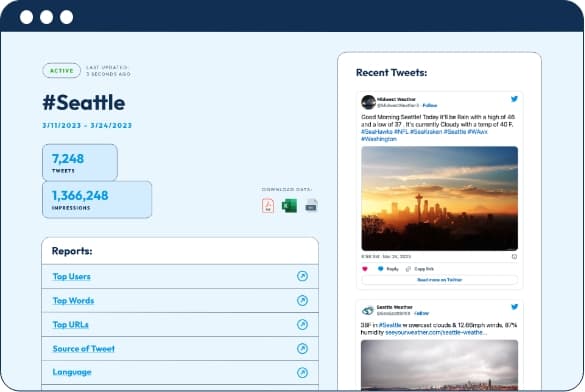
- Unlimited historical archiving - Collect and store tweets indefinitely (past Twitter's API limits)
- Hashtag and keyword tracking - Monitor specific campaigns, events, or topics
- No volume limits - Archive as many tweets as you need without restrictions
- Advanced search - Boolean operators, date ranges, user filtering
- Sentiment analysis - Automatic classification of tweet sentiment
- Export capabilities - Download data to Excel, CSV, or PDF for custom analysis
- Visual analytics - Charts, graphs, and word clouds
- Real-time + historical - Track current conversations and access archived data
Pros:
- Excels at long-term historical data collection (most tools limited to 30 days)
- No tweet volume caps—great for high-volume campaigns
- Affordable compared to enterprise platforms
- Easy to use interface
- Strong export options for custom analysis
Cons:
- Focused primarily on Twitter (not a multi-platform tool)
- Limited team collaboration features compared to enterprise tools
- Analytics less advanced than tools like Sprout Social
Best Use Cases:
- Tracking conference or event hashtags
- Long-term campaign measurement
- Academic and market research requiring historical data
- Brands needing comprehensive hashtag performance analysis
Try Tweet Archivist free for 14 days
2. Brand24
Best for: Brand reputation monitoring, real-time alerts, small to medium businesses
Pricing: From $79/month (billed annually)
Key Features:
- Real-time monitoring - Instant notifications for brand mentions
- Sentiment analysis - Automatic positive/negative/neutral classification
- Influencer score - Identify high-reach users mentioning your brand
- Discussion volume charts - Visualize mention trends over time
- Multi-platform - Twitter, Facebook, Instagram, YouTube, forums, blogs, news
- Alerts - Email, Slack notifications for important mentions
- Competitor tracking - Compare your brand mentions to competitors
Pros:
- Excellent real-time alerting system
- Clean, intuitive interface
- Good value for small to medium businesses
- Multi-platform coverage (not just Twitter)
- Strong customer support
Cons:
- Limited historical data (30 days typically)
- Mention limits on lower-tier plans can be restrictive
- Sentiment analysis accuracy varies
- Reporting features less robust than enterprise tools
Best Use Cases:
- Brand reputation monitoring and crisis detection
- Competitive intelligence
- PR and communications teams needing real-time alerts
- Small businesses wanting affordable multi-platform monitoring
3. Sprout Social
Best for: Enterprise teams, comprehensive social media management, detailed analytics
Pricing: From $249/month per user
Key Features:
- Unified inbox - All Twitter mentions, DMs, and messages in one place
- Advanced analytics - Deep-dive reports on engagement, sentiment, trends
- Team collaboration - Assign tasks, track conversations, approval workflows
- Custom reports - Drag-and-drop report builder
- Social listening - Track keywords, hashtags, competitors across platforms
- Competitor benchmarking - Compare your performance to competitors
- Integration hub - Connect to CRM, helpdesk, Google Analytics, and more
- Publishing and scheduling - Full social media management suite
Pros:
- Most comprehensive feature set (listening, publishing, analytics, CRM)
- Best-in-class analytics and reporting
- Excellent team collaboration tools
- Strong integration ecosystem
- Outstanding customer support and training resources
Cons:
- Expensive, especially for multiple users
- Can be overwhelming for small teams or simple use cases
- Social listening requires Premium plan ($399/user/month)
- Steep learning curve due to feature depth
Best Use Cases:
- Large marketing teams managing multiple social accounts
- Agencies serving multiple clients
- Enterprises needing comprehensive social media platform
- Brands requiring advanced analytics and custom reporting
4. Hootsuite
Best for: Multi-account management, agencies, established social media teams
Pricing: From $99/month, listening add-on from additional $299/month
Key Features:
- Multi-account dashboard - Manage up to 50 social accounts
- Streams - Customizable real-time feeds for mentions, hashtags, searches
- Social listening (add-on) - Track millions of conversations across platforms
- Team management - Assign tasks, require approvals, track team performance
- Bulk scheduling - Upload CSV to schedule hundreds of posts
- App directory - 100+ integrations with other tools
- Advanced analytics - Customizable reports and dashboards
Pros:
- Excellent multi-account management (great for agencies)
- Mature platform with extensive integrations
- Flexible team permissions and workflows
- Strong competitor analysis features
- Wide range of training and certification programs
Cons:
- Social listening is expensive add-on (not included in base plans)
- Interface feels dated compared to newer tools
- Pricing becomes expensive as you scale
- Customer support quality has declined in recent years
Best Use Cases:
- Agencies managing many client accounts
- Social media teams handling multiple brand accounts
- Organizations with complex approval workflows
- Businesses already invested in Hootsuite ecosystem
5. Keyhole
Best for: Event tracking, influencer marketing, hashtag campaigns
Pricing: From $79/month
Key Features:
- Real-time hashtag tracking - Monitor campaign hashtags as they trend
- Event dashboards - Live displays for conferences and events
- Influencer identification - Find and track key voices in your campaigns
- Historical hashtag data - Access past campaign performance
- Geographic tracking - See where conversations are happening
- Competitive hashtag analysis - Compare your campaigns to competitors
- Public dashboards - Shareable live dashboards (great for event displays)
Pros:
- Best real-time hashtag and event tracking
- Affordable pricing for small to medium businesses
- Clean visualizations and shareable dashboards
- Fast setup—start tracking in minutes
- Good influencer identification features
Cons:
- Limited beyond hashtag/keyword tracking (not full social management suite)
- Sentiment analysis less accurate than competitors
- Reporting customization limited
- No direct posting or engagement features
Best Use Cases:
- Event marketers tracking conference hashtags
- PR teams monitoring campaign reach
- Influencer marketing campaign measurement
- Brands running hashtag contests or campaigns
Learn more about campaign tracking in our hashtag analytics guide.
6. Mention
Best for: Real-time brand monitoring, crisis management, media monitoring
Pricing: From $49/month
Key Features:
- Real-time monitoring - Immediate alerts across web and social media
- Boolean search - Complex queries with AND, OR, NOT operators
- Sentiment analysis - Automatic classification with manual override
- Influencer tracking - Identify key voices and their reach
- Team collaboration - Assign mentions, add notes, track status
- Multi-language support - Monitor conversations in 100+ languages
- API access - Pull data for custom integrations
Pros:
- Excellent real-time alerting (one of the fastest)
- Monitors Twitter + web (blogs, news, forums)
- Affordable entry-level pricing
- Good boolean search capabilities
- Clean, user-friendly interface
Cons:
- Historical data limited to plan tier
- Analytics less comprehensive than enterprise tools
- Mention limits can be restrictive on lower tiers
- No built-in publishing features
Best Use Cases:
- PR teams needing fast crisis detection
- Reputation management across Twitter and web
- Small businesses wanting affordable monitoring
- Media monitoring for mentions in news and blogs
7. Brandwatch (formerly Crimson Hexagon)
Best for: Enterprise-level social intelligence, AI-powered insights, market research
Pricing: Custom enterprise pricing (typically $1,000+/month)
Key Features:
- Massive data access - Historical Twitter data back to 2006
- AI-powered analysis - Advanced machine learning for insights
- Image recognition - Detect your logo in images even without text mentions
- Audience segmentation - Deep demographic and psychographic analysis
- Custom dashboards - Unlimited customization and visualization
- API access - Full data export for custom analysis
- Dedicated support - Customer success managers and training
Pros:
- Most powerful analytics and AI capabilities
- Deepest historical data access
- Best for large-scale market research
- Excellent data visualization
- Enterprise-grade security and compliance
Cons:
- Very expensive (out of reach for SMBs)
- Complexity requires dedicated analyst or training
- Overkill for basic brand monitoring needs
- Custom pricing makes budgeting difficult
Best Use Cases:
- Global enterprises with complex listening needs
- Market research firms
- Brands needing deep consumer insights and trend analysis
- Organizations with dedicated social intelligence teams
8. Talkwalker
Best for: Global brands, multi-language monitoring, visual analytics
Pricing: Custom enterprise pricing (typically $800+/month)
Key Features:
- Multi-language monitoring - 187 languages supported
- Visual listening - Logo and image recognition across social media
- AI sentiment analysis - Advanced emotion detection (joy, anger, sadness, etc.)
- Influencer identification - Track reach and impact of key voices
- Crisis detection - Anomaly detection and automated alerts
- Customizable dashboards - Build unlimited custom views
- Historical data - 2+ years of historical Twitter data
Pros:
- Best multi-language support
- Excellent visual analytics and image recognition
- Strong crisis detection capabilities
- Global coverage across platforms
- Beautiful data visualizations
Cons:
- Expensive enterprise pricing
- Learning curve for full feature utilization
- May be overly complex for simple use cases
- Contract lengths typically annual or longer
Best Use Cases:
- Global brands operating in multiple languages
- Companies concerned with visual brand mentions (logo detection)
- Large enterprises with sophisticated listening needs
- Crisis management and reputation monitoring at scale
Side-by-Side Tool Comparison
Here's a quick comparison of key features and pricing:
| Tool | Starting Price | Historical Data | Sentiment Analysis | Real-Time Alerts | Multi-Platform | Best For |
|---|---|---|---|---|---|---|
| Tweet Archivist | $49/mo | Unlimited | Yes | Yes | No (Twitter only) | Historical archiving, hashtag tracking |
| Brand24 | $79/mo | 30 days | Yes | Yes | Yes | Brand monitoring, SMBs |
| Sprout Social | $249/mo/user | Varies by plan | Yes (Premium) | Yes | Yes | Enterprise teams, full social suite |
| Hootsuite | $99/mo + $299 listening | Varies by plan | Yes (add-on) | Yes | Yes | Agencies, multi-account management |
| Keyhole | $79/mo | 30 days | Yes | Yes | Limited | Event tracking, influencer marketing |
| Mention | $49/mo | Varies by plan | Yes | Yes | Yes | Crisis management, media monitoring |
| Brandwatch | $1,000+/mo (custom) | 2006+ | Yes (AI-powered) | Yes | Yes | Enterprise, market research |
| Talkwalker | $800+/mo (custom) | 2+ years | Yes (AI emotion) | Yes | Yes | Global brands, visual listening |
Feature Checklist
| Feature | Tweet Archivist | Brand24 | Sprout Social | Hootsuite | Keyhole | Mention |
|---|---|---|---|---|---|---|
| Free Trial | 14 days | 14 days | 30 days | 30 days | Demo only | 14 days |
| Boolean Search | Yes | Limited | Yes | Yes | Limited | Yes |
| Unlimited Keywords | Yes | No (plan limits) | Varies | Varies | No | No |
| Export Data | Excel, CSV, PDF | Excel, PDF | Excel, PDF | Excel, CSV | CSV, PDF | Excel |
| Team Collaboration | Limited | Yes | Yes | Yes | Limited | Yes |
| White-Label Reports | No | Yes (higher tiers) | Yes | Yes | Yes | No |
| API Access | Enterprise only | Yes (higher tiers) | Yes | Yes | Yes | Yes |
| Direct Posting | No | No | Yes | Yes | No | No |
How to Choose the Right Tool for Your Needs
With so many options, how do you decide? Consider these factors:
1. Define Your Primary Use Case
Brand Reputation Monitoring? → Brand24, Mention, Sprout Social
Long-Term Campaign Tracking? → Tweet Archivist, Brandwatch
Real-Time Event Coverage? → Keyhole, Hootsuite
Full Social Media Management + Listening? → Sprout Social, Hootsuite
Market Research & Analysis? → Brandwatch, Talkwalker
Hashtag Campaign Measurement? → Tweet Archivist, Keyhole
2. Consider Your Budget
Under $100/month: Tweet Archivist ($49), Mention ($49), Brand24 ($79), Keyhole ($79)
$100-$500/month: Hootsuite ($99+), Sprout Social ($249+)
Enterprise ($500+): Brandwatch, Talkwalker, Sprout Social Premium
Remember to factor in costs beyond base pricing:
- Per-user fees (some tools charge per seat)
- Add-on features (listening modules, advanced analytics)
- Setup and training costs
- Contract length commitments
3. Assess Your Team Size and Workflow
Solo or small team (1-3 people): Tweet Archivist, Brand24, Mention, Keyhole
Medium team (4-10 people): Hootsuite, Sprout Social
Large enterprise team: Sprout Social, Brandwatch, Talkwalker
Agency managing multiple clients: Hootsuite, Sprout Social
4. Evaluate Technical Requirements
Need API access for custom integrations? → Sprout Social, Hootsuite, Brandwatch
Want white-label reporting for clients? → Sprout Social, Hootsuite, Keyhole
Require historical data beyond 30 days? → Tweet Archivist, Brandwatch
Need multi-language support? → Talkwalker, Brandwatch
5. Test Before You Commit
Always take advantage of free trials:
- Test with real keywords and use cases (not just generic examples)
- Evaluate accuracy of sentiment analysis
- Assess ease of use for your team's skill level
- Check customer support responsiveness during trial
- Compare data quality across multiple tools in parallel trials
6. Plan for Growth
Choose a tool that can scale with your needs:
- What happens when you exceed your plan limits?
- Can you easily upgrade tiers or add users?
- Will historical data from lower tiers be retained if you upgrade?
- Are there enterprise options if your needs become complex?
Decision Framework
For Small Businesses & Startups:
Start with Tweet Archivist (if focused on Twitter campaigns/hashtags) or Brand24 (if you need multi-platform monitoring). Both offer excellent value under $100/month with powerful features for small teams.
For Growing Businesses:
Sprout Social or Hootsuite provide comprehensive social management + listening in one platform. Higher cost but eliminates need for multiple tools as you scale.
For Enterprises:
Brandwatch or Talkwalker offer the most sophisticated analysis, deepest data access, and enterprise-grade features for large organizations with complex needs and dedicated analysts.
For Event Marketers:
Keyhole excels at real-time event and hashtag tracking with shareable dashboards perfect for live events and conferences.
For Agencies:
Hootsuite or Sprout Social with multi-client management, white-label reporting, and team collaboration features designed for agency workflows.
Getting Started with Twitter Listening
Once you've chosen a tool, follow these best practices for successful implementation:
1. Set Up Tracking Strategically
Brand Mentions:
- Your brand name (exact and common misspellings)
- Product names
- Executive names (CEO, founders)
- Brand-specific hashtags
- Common abbreviations or nicknames for your brand
Competitors:
- Direct competitor brand names
- Competitor products
- Industry comparison keywords ("Brand A vs Brand B")
Industry Topics:
- Relevant industry keywords and jargon
- Pain points your product solves
- Trending topics in your space
Campaign Tracking:
- Campaign-specific hashtags
- URL shortlink variations
- Campaign taglines or phrases
Use hashtag analytics to identify the most valuable keywords and hashtags to monitor.
2. Configure Alerts Wisely
Don't set up alerts for every mention—you'll drown in notifications:
- High priority - Negative sentiment spikes, high-reach influencer mentions, crisis keywords
- Medium priority - Customer service inquiries, competitor mentions
- Low priority - General brand mentions, positive sentiment (review in dashboard, not alerts)
Customize delivery methods:
- Email for medium-priority items (check 2-3x daily)
- SMS or Slack for urgent/crisis alerts only
- In-app notifications for low-priority items
3. Establish Response Protocols
Define who responds to what, and how quickly:
- Customer service issues - Support team responds within 1 hour during business hours
- Positive mentions - Social media team likes/retweets within 24 hours
- Influencer mentions - Marketing lead responds personally within 2 hours
- Crisis/negative spikes - Escalate to PR team immediately
- Sales opportunities - Alert sales team within 4 hours
4. Create a Weekly Review Routine
Don't just monitor—analyze and act:
- Monday: Review previous week's mention volume, sentiment trends
- Wednesday: Check competitor mention analysis
- Friday: Identify top influencers and engage, plan next week's content based on trending topics
5. Integrate with Your Workflow
Connect listening tools to your existing systems:
- Push negative mentions to customer service ticketing system
- Send positive testimonials to marketing team for potential case studies
- Alert sales team when prospects mention buying intent keywords
- Feed trending topics into content calendar planning
For comprehensive Twitter strategy including listening, see our Twitter marketing strategy guide.
6. Measure and Optimize
Track these metrics to ensure your listening efforts deliver ROI:
- Response time - Are you responding fast enough?
- Mention volume trends - Growing or declining?
- Sentiment trends - Improving or worsening over time?
- Share of voice vs. competitors - Gaining or losing ground?
- Actionable insights generated - How many product/marketing improvements came from listening?
- Crisis prevention - How many potential issues were caught early?
Future of Twitter Listening Tools
The Twitter listening landscape continues to evolve. Here are trends shaping the future:
1. AI and Machine Learning Advances
- More accurate sentiment analysis - Better understanding of sarcasm, context, and nuance
- Predictive analytics - Forecasting trends before they peak
- Automated insights - AI surfacing important patterns without manual analysis
- Emotion detection - Beyond positive/negative to joy, anger, fear, surprise
2. Visual and Video Analysis
- Logo detection - Finding your brand in images even without text mentions
- Scene recognition - Understanding context of images (your product in use, etc.)
- Video content analysis - Transcription and analysis of video mentions
3. Integration with Customer Data Platforms
- Unified customer profiles combining social listening with CRM, purchase history, and support interactions
- Better attribution of social mentions to customer lifetime value
- Personalized engagement based on complete customer context
4. Real-Time Action Automation
- Automated responses to common customer service questions
- Dynamic alert routing based on mention content and priority
- Triggered workflows in other systems based on social listening data
5. Privacy and Compliance Features
- Enhanced data privacy controls for GDPR, CCPA compliance
- Better PII detection and anonymization
- Audit trails for regulatory compliance
Start Listening Smarter Today
Twitter listening tools transform scattered social conversations into structured business intelligence. The right tool depends on your specific needs, budget, and scale—but every business can benefit from monitoring what customers, competitors, and the market are saying in real-time.
Start with a clear use case (brand monitoring, campaign tracking, competitive intelligence, etc.), test tools with free trials, and choose the platform that best fits your workflow and goals.
Ready to archive and analyze your Twitter conversations? Try Tweet Archivist free for 14 days to track unlimited historical Twitter data, measure campaign performance, and gain insights from your social conversations.