Social Media Archiving: The Complete Guide for Compliance, Legal, and Records Management
What Is Social Media Archiving?
Social media archiving is the systematic process of capturing, preserving, and indexing social media content in a tamper-evident, searchable format for long-term retention. Unlike a simple screenshot or manual export, proper social media archiving creates a defensible, time-stamped record of exactly what was posted — including metadata, edit history, and engagement data — in a format that satisfies legal and regulatory requirements.
At its core, archiving social media is about converting ephemeral online content into permanent, auditable records. A tweet deleted five minutes after posting, a Facebook post quietly edited, a LinkedIn update that gets taken down — a proper archiving system captures all of it at the moment of publication and preserves the chain of custody needed to use that evidence in court or produce it to a regulator.
Archiving vs. monitoring vs. backup:
- Monitoring tracks mentions and engagement in real time — it is forward-looking and often disposable. Alerts fire, analysts review, and the raw data is rarely preserved in a legally defensible way.
- Backup preserves data for disaster recovery. It is designed to restore systems, not to produce records in litigation. Backups are regularly overwritten and lack the metadata provenance that legal and compliance teams require.
- Archiving captures and retains records with full context, timestamps, and chain-of-custody documentation for a defined retention period. It is built for discovery, audit, and regulatory production.
This distinction matters enormously in practice. A social media manager who “backed up” company tweets in a spreadsheet will struggle to satisfy a FINRA examination request or a litigation hold. Proper social media archiving software generates records that can withstand scrutiny.
Why Social Media Archiving Matters
Social media has become a primary communication channel for organizations of every size — and regulators, courts, and oversight bodies have taken notice. What gets posted on Twitter, LinkedIn, Instagram, or Facebook is now squarely within the scope of legal discovery, regulatory examination, and public records law.
The Legal Landscape
Federal courts have consistently held that social media content is discoverable evidence subject to the same preservation obligations as email or internal documents. The Federal Rules of Civil Procedure require organizations to preserve electronically stored information (ESI) — and social media posts qualify — once litigation is reasonably anticipated. Failure to preserve that content can result in sanctions, adverse inference instructions, or default judgments.
Courts have sanctioned organizations for failing to preserve social media evidence in employment disputes, securities fraud cases, contract litigation, and intellectual property claims. The costs of spoliation — both monetary sanctions and reputational damage — far exceed the cost of maintaining a proper archiving solution in advance.
The Regulatory Landscape
Regulators across industries now explicitly address social media in their rules and guidance:
- FINRA Rule 4511 requires broker-dealers to preserve all business communications — including social media posts used to communicate with clients — for at least three years (six years for certain records). Social media posts that constitute “advertisements” or “sales literature” require pre-approval and archiving.
- SEC Rule 17a-4 imposes strict requirements on the format of archived records: they must be stored in a non-rewriteable, non-erasable format (WORM), indexed, and accessible to examiners on demand.
- HIPAA does not regulate social media directly but imposes breach notification obligations when patient information is disclosed publicly — including in social media posts. Archiving helps organizations identify and document such incidents.
- FOIA and state public records laws require government agencies to produce communications — including social media posts made on official accounts — in response to public records requests.
The penalty risk is real. FINRA and the SEC have levied seven-figure fines against financial firms specifically for social media recordkeeping failures. Several state attorneys general have sued government agencies for deleting public social media records subject to FOIA obligations.
Reputational and Operational Risk
Beyond legal and regulatory exposure, organizations archive social media to manage operational risk. Employees post on official accounts, disputes arise over what was communicated and when, and brand crises unfold in real time. An archive provides an accurate record that cuts through “he said, she said” disputes and enables rapid, accurate responses to complaints, press inquiries, and internal investigations.
Key Use Cases: Legal, Compliance, and Records
Litigation Holds
When litigation is filed or reasonably anticipated, organizations must issue a litigation hold: a formal instruction to preserve all potentially relevant information. Social media content is increasingly central to these holds. Employment discrimination cases turn on what a manager posted on LinkedIn. Contract disputes hinge on what a company advertised on Twitter. Securities fraud cases examine what executives communicated publicly versus what they said privately.
Effective litigation hold compliance requires social media archiving software that:
- Captures content at the moment of publication, not retrospectively
- Preserves deleted and edited posts with their original versions
- Maintains full metadata (author, timestamp, platform, engagement data)
- Enables legal holds to be placed on specific accounts or date ranges
- Produces exports in formats accepted by eDiscovery platforms (EDRM XML, PST, PDF with metadata)
Organizations without an archiving solution in place before litigation arises will find retroactive preservation extremely difficult. Social media platforms limit historical data access through their APIs, and some content may already be deleted or edited by the time a hold is issued.
Regulatory Compliance and Examinations
Regulatory examinations increasingly include social media as a matter of course. FINRA examiners routinely request samples of a broker-dealer’s social media posts. SEC staff requests in enforcement investigations commonly include social media communications. State banking regulators and insurance commissioners have followed suit.
Organizations subject to these examinations need social media archiving solutions that produce records in formats regulators recognize and accept — typically WORM-compliant storage with search and export capabilities that can respond to examiner requests within required timeframes.
FOIA and Public Records Compliance
Government agencies at the federal, state, and local level increasingly conduct official business on social media. Agency Twitter accounts announce policy decisions. Police departments post incident information on Facebook. City councils use social media to communicate with constituents.
All of this content may be subject to public records requests. Archiving social media for government entities ensures that agencies can respond to FOIA requests accurately and completely, without the risk of being unable to produce records that are legally required to be preserved.
HR Investigations
Social media posts are frequently at the center of workplace investigations. Harassment claims, policy violations, conflicts of interest, and discriminatory conduct often surface on social platforms. HR teams need the ability to retrieve a complete, authentic record of what an employee posted — including posts that may have been deleted after the complaint was filed.
Social media archiving software captures this evidence at the time of publication, ensuring that the record available to HR investigators reflects what was actually posted, not a curated version cleaned up after the fact.
Corporate Records and Brand Governance
Large organizations with multiple social media accounts and dozens of team members posting need archiving for purely operational reasons: to maintain an accurate corporate record of what was communicated publicly, to enforce brand standards, and to document the history of campaigns, announcements, and customer communications.
Industry-Specific Requirements
Financial Services: Broker-Dealers and Investment Advisers
Social media archiving for financial advisors is one of the most demanding and well-defined compliance requirements. FINRA and the SEC have issued detailed guidance on social media use in financial services, and enforcement has been consistent.
What the rules require:
- All business-related social media communications must be retained for at least three years (broker-dealers) or five years (investment advisers under the Investment Advisers Act)
- Records must be stored in a non-rewriteable, non-erasable format compliant with SEC Rule 17a-4(f) or Rule 204-2
- Firms must designate a principal to review and approve social media content that constitutes advertising or sales literature
- Third-party social media archiving solutions used by broker-dealers must meet the WORM and indexing standards specified by the SEC
Common compliance failures:
- Allowing registered representatives to use personal social media accounts for client communications without archiving
- Retaining only screenshots rather than metadata-complete records
- Failing to archive all platforms in use (capturing LinkedIn but not Twitter, for example)
- Not having a written social media policy that addresses recordkeeping obligations
Social media archiving software for financial services must integrate with the firm’s overall books-and-records infrastructure and produce records that can be provided to FINRA or SEC examiners on demand, typically within 24 hours of a request.
Government and Law Enforcement
Social media archiving for government agencies operates under a different but equally stringent set of requirements. Public records laws — federal FOIA and state equivalents — cover official government social media accounts. Some states have expanded their records retention statutes to explicitly address social media.
Social media archiving for police departments presents particular challenges. Departments use platforms like Twitter, Facebook, and Nextdoor to communicate with the public about incidents, investigations, and public safety information. This content is subject to public records requests and, increasingly, civil rights litigation discovery. Departments must preserve posts made on official accounts, including deleted posts, for the applicable retention period — which varies by state but is commonly three to seven years for general public communications.
Key requirements for government archiving:
- Capture of official account content at the time of posting, including edit history
- Tamper-evident storage that demonstrates authenticity for FOIA production
- Search capabilities to identify responsive records across date ranges, keywords, and platforms
- Retention schedules aligned with applicable state records retention laws
- Audit logs documenting who accessed records and when
Government archiving solutions must also accommodate the political sensitivity of the records. Oversight bodies, journalists, and advocacy organizations actively submit FOIA requests for government social media content. An agency that cannot produce complete records on demand faces both legal liability and significant reputational damage.
Healthcare
Healthcare organizations use social media for patient outreach, community education, and brand building. The HIPAA risk lies at the intersection of those communications and patient information. Archiving enables healthcare compliance teams to document that patient information was not disclosed in social media posts and to respond quickly if a potential breach is identified.
Hospitals, health systems, and medical practices also face increasingly active social media presences from individual physicians and staff. Archiving official organization accounts — and monitoring employee accounts for potential HIPAA disclosures — is an emerging area of healthcare compliance.
Legal Firms
Law firms themselves use social media for marketing, thought leadership, and client development. Bar association rules on attorney advertising apply to social media posts, and many state bars require that attorney advertising be retained for a defined period — commonly two years — for potential bar complaint proceedings.
Law firms also advise clients on social media compliance and litigation holds, making them consumers of social media archiving solutions on behalf of clients as well as potential users for their own compliance needs.
How Social Media Archiving Works
Understanding the technical mechanics of social media archiving helps organizations evaluate solutions and understand what they are getting — and what they are not.
Capture
The first step is content capture: actually retrieving social media posts and their associated metadata from the platforms where they are published. There are three primary capture methods:
API-based capture uses the official application programming interface provided by each social media platform. The archiving system connects to the platform’s API, retrieves posts and metadata, and stores them. API capture is reliable and produces structured data but is subject to the API access limitations each platform imposes — including rate limits, historical data restrictions, and potential API changes when platforms update their policies.
Web-based capture (crawling) retrieves content by accessing the public-facing web version of social media profiles, similar to how a search engine indexes web pages. This approach is less dependent on API access but produces less structured data and may not capture all metadata.
RSS and feed-based capture is used for platforms that publish content feeds. It is simpler but limited in the metadata it captures.
The most complete archiving solutions combine API and web-based capture to maximize coverage and resilience to platform changes.
Indexing
Captured content must be indexed to be searchable. Indexing extracts the text of posts, metadata fields (author, date, platform, URL), and associated media, and builds a searchable database. Good indexing enables full-text search across millions of archived posts, date-range filtering, account-based filtering, and faceted search by platform or content type.
For organizations responding to regulatory examinations or eDiscovery requests, the quality of indexing directly determines how efficiently they can identify and produce responsive records.
Storage and Chain of Custody
Archived records must be stored in a way that demonstrates they have not been altered since capture. For regulated industries, this means WORM-compliant storage — non-rewriteable, non-erasable formats that prevent any modification of archived records. WORM storage, combined with cryptographic hashing of content at the time of capture, creates a verifiable chain of custody.
The archive should also maintain a complete audit log: who accessed records, when, what searches were run, and what was exported. This audit trail is itself a record that may be produced in litigation or examination.
Search and Retrieval
The practical value of an archive lies in retrieval. When a regulator requests all communications relating to a specific client, or litigation counsel issues a hold on all posts mentioning a particular topic, the archive must enable rapid, accurate identification of responsive content. This requires:
- Full-text search across all archived content
- Boolean and proximity search operators
- Date range filtering
- Account and platform filtering
- Saved searches and legal hold functionality
- Export in formats compatible with eDiscovery review platforms
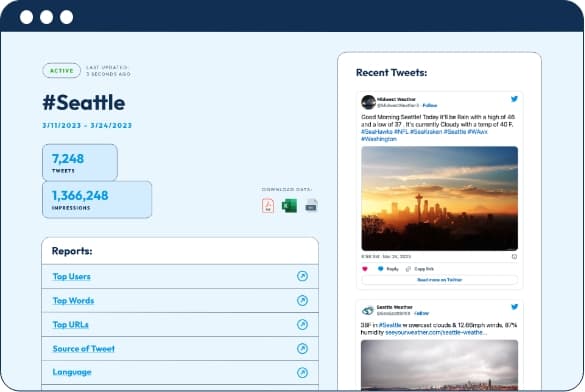
Tweet Archivist is built around exactly these capabilities for Twitter content — enabling organizations to search, filter, and export archived tweets with full metadata in formats suitable for legal and compliance use.
Retention and Disposition
Archiving is not permanent retention. Organizations need retention schedules that specify how long different categories of social media records are kept before disposition. These schedules should align with applicable regulatory requirements and litigation hold policies. A sound archiving solution supports automated retention scheduling and defensible disposition — the ability to document why records were deleted after their required retention period expired.
What to Look for in Social Media Archiving Tools
The market for social media archiving software has grown considerably as organizations have recognized the compliance requirements. Evaluating solutions requires understanding what separates genuine archiving tools from simple monitoring or backup products.
Platform Coverage
No single platform dominates organizational social media use. Most organizations need to archive content from Twitter/X, LinkedIn, Facebook, and Instagram at a minimum. Some industries have platform-specific needs: financial advisors may need YouTube for video content; government agencies may need Nextdoor. Evaluate whether the solution covers all platforms your organization uses and whether it captures platform-specific content types (Twitter threads, LinkedIn articles, Instagram Stories).
Capture Completeness
The archive is only as good as what it captures. Key questions include:
- Does the solution capture deleted posts before deletion?
- Does it capture edited posts with version history?
- Does it capture media (images, videos) attached to posts, not just text?
- Does it capture replies, quote tweets, and comments?
- Does it capture metadata (engagement counts, geolocation data, device information)?
For legal and regulatory purposes, the metadata is often as important as the content itself.
Compliance Certifications
For regulated industries, verify that the solution meets applicable technical standards. Financial services firms should look for solutions that explicitly support SEC Rule 17a-4(f) WORM compliance. Government agencies should look for FedRAMP authorization or equivalent state certifications. Healthcare organizations should confirm HIPAA-compliant data processing and storage.
Search and eDiscovery Capabilities
Legal and compliance teams need to locate responsive records quickly. Evaluate the search interface directly — does it support the operators and filters your team will actually use? Can it export in formats your eDiscovery platform accepts? Does it support legal hold tagging so specific content can be flagged for preservation beyond the standard retention schedule?
Audit Trail and Reporting
A defensible archive requires a defensible audit trail. The solution should log all access to archived records, all searches, and all exports. These logs demonstrate that records were not tampered with and provide documentation of the review process in litigation or examination scenarios.
Integration with Existing Systems
Social media archiving does not operate in isolation. Consider how the solution integrates with your existing records management infrastructure, eDiscovery platform, legal hold management system, and compliance monitoring tools. Some archiving solutions offer direct integrations with platforms like Relativity, Everlaw, or Logikcull.
Scalability and Performance
Large organizations with active social media presences generate significant volumes of archived content. Evaluate whether the solution can handle your expected volume and whether search performance degrades as the archive grows. Ask vendors for benchmarks on search performance at scale.
Pricing and Retention Economics
Social media archiving pricing varies widely. Some solutions charge per account archived; others charge by volume of content stored. Understand the full cost over the required retention period, including storage costs as the archive grows. A solution that appears inexpensive per month may become costly when retention schedules require keeping records for five or six years.
Best Practices for Social Media Archiving Policies
Technology alone is insufficient. A complete social media archiving program requires written policies, defined procedures, and trained personnel.
Establish a Written Social Media Policy
Every organization that uses social media should have a written policy that addresses:
- Which accounts are considered official organizational accounts subject to recordkeeping requirements
- What personal account activity by employees constitutes a business communication requiring retention
- Who is authorized to post on official accounts and what approval process applies
- How long different categories of social media records are retained
- How litigation holds affecting social media content are communicated and implemented
For regulated industries, this policy should be reviewed by compliance counsel and updated whenever regulatory guidance changes.
Define Retention Schedules Aligned with Regulations
Retention schedules for social media should align with the most demanding applicable requirement. A broker-dealer that archives general marketing posts for two years but is required by FINRA to keep them for three years has a compliance gap. Map each category of social media content to its applicable retention requirement and configure the archiving system accordingly.
Consider that different content types may have different retention requirements:
- General brand communications: typically two to three years
- Client-facing communications (financial services): three to six years
- Employment-related posts: applicable state statute of limitations for employment claims
- Government agency communications: applicable state records retention schedule
- Content subject to active litigation hold: indefinitely until hold is lifted
Implement a Litigation Hold Process for Social Media
When litigation is filed or anticipated, the legal team must be able to quickly implement a hold on relevant social media content. This requires:
- A defined process for identifying and notifying custodians whose social media activity must be preserved
- Capability in the archiving system to tag held content so it is not subject to routine disposition
- Documentation of when the hold was imposed and what content it covers
The hold process should be exercised and tested before it is needed. Organizations that have never run through the process discover gaps at the worst possible time.
Train Employees on Social Media Recordkeeping
Employees posting on official organizational accounts need to understand that their posts are subject to recordkeeping requirements. Training should cover:
- Which platforms and accounts are archived
- Why deletion of posts may have legal consequences
- How to respond if they receive a litigation hold notice affecting their social media activity
- The organization’s policy on personal account use for business communications
Conduct Regular Compliance Audits
Archiving systems require maintenance. Platforms change their APIs, new platforms emerge, and organizational social media use evolves. Regular audits should verify:
- That all official accounts are being captured by the archiving system
- That capture is complete and not experiencing gaps due to API changes or system errors
- That retention schedules are correctly configured and disposition is occurring as planned
- That the search and export functionality works as expected for the organization’s use cases
Document the Archiving Program
In litigation and regulatory examinations, organizations are frequently asked to describe their records management program, including social media archiving. Maintaining documentation of the program — the policy, the retention schedule, the technical solution in use, and audit records — enables organizations to demonstrate the adequacy of their compliance program and respond to inquiries efficiently.
Frequently Asked Questions
Do I need to archive personal social media accounts used for business?
Yes, in many cases. If an employee uses a personal Twitter or LinkedIn account to communicate with clients or prospects in a business capacity, those communications may be subject to the same retention requirements as official account posts. FINRA has been particularly clear on this point for registered representatives in financial services. Organizations should address personal account use explicitly in their social media policy and have a mechanism for capturing business-related personal account communications.
What happens if content is deleted before it can be archived?
This is why proactive archiving — capturing content at the time of publication — is essential. Retroactive preservation of deleted content is extremely difficult. Most social media platforms do not provide API access to deleted posts. If your organization is implementing archiving for the first time, you cannot recover content that was deleted before archiving began. For new content going forward, a properly configured archiving system will capture posts at the moment of publication, before any deletion occurs.
Are screenshots sufficient for legal and regulatory purposes?
Generally, no. Screenshots lack the metadata — timestamps, author information, platform-verified authenticity — that makes records defensible. A screenshot can be fabricated or altered; a properly authenticated archive record with a cryptographic hash cannot be. Regulators, courts, and opposing counsel in litigation increasingly scrutinize screenshots and may challenge their admissibility. Invest in proper social media archiving software rather than relying on screenshots as your primary preservation method.
How long do I need to keep social media records?
It depends on your industry and jurisdiction. Common requirements include: three years for FINRA broker-dealers, five years for SEC-registered investment advisers, two to seven years for government agencies under state public records laws, and the applicable statute of limitations for employment-related content. Your legal and compliance team should define a retention schedule based on the regulations that apply to your organization.
Can I archive competitors’ social media accounts?
Yes. Public social media content posted by competitors, counterparties, or other organizations is accessible and archivable. This is commonly done for competitive intelligence, brand monitoring, and in litigation preparation. Archiving public content from third-party accounts raises no legal issues — that content is publicly accessible. Tools like Tweet Archivist support archiving of any public Twitter account, making it straightforward to build a comprehensive archive of competitor or counterparty Twitter activity for research or litigation preparation.
What’s the difference between social media monitoring and archiving?
Monitoring tools track mentions, engagement, and trends in real time. They are designed for day-to-day brand management and customer engagement. Archiving tools are designed for long-term records preservation with chain-of-custody documentation suitable for legal and regulatory purposes. Many organizations use both: monitoring for operational purposes and archiving for compliance. The outputs are different: monitoring produces dashboards and alerts; archiving produces legally defensible records.
Do social media archiving solutions work with all platforms?
Coverage varies by vendor and is subject to change as platforms update their API access policies. Twitter/X, LinkedIn, Facebook, and Instagram are covered by most enterprise archiving solutions. Newer platforms and niche networks may have limited coverage. Verify with any vendor that the specific platforms you need to archive are fully supported, and ask about their process for maintaining coverage when platforms change their APIs.
What is WORM compliance and why does it matter for archiving?
WORM stands for Write Once, Read Many — a storage standard that prevents any modification or deletion of stored records. SEC Rule 17a-4(f) requires broker-dealers to store electronic records in a WORM-compliant format. This ensures that archived records cannot be altered after the fact and provides a verifiable, tamper-evident record suitable for regulatory examination. Not all archiving solutions offer WORM-compliant storage; this is a critical evaluation criterion for organizations in regulated industries.