How to Find Old Tweets: Complete Search Guide (2026)
Why Search for Old Tweets?
Whether you're tracking down that viral tweet from 2018, researching historical conversations, or analyzing your own Twitter journey, finding old tweets has become an essential skill for social media users, researchers, and marketers alike.
The need to search old tweets spans numerous use cases. Content creators hunt for inspiration in their past successes, discovering which tweets resonated with their audience months or years ago. Brand managers monitor historical mentions for reputation management and trend analysis. Journalists fact-check statements by searching through years of public tweets. Compliance teams archive conversations for legal and regulatory requirements.
Yet Twitter's interface presents a frustrating challenge: scroll endlessly through thousands of tweets, or master the search tools that most users never discover. This guide reveals both—the official methods built into Twitter (now X) and the powerful third-party solutions that unlock your complete Twitter history.
The truth is, Twitter displays only your most recent 3,200 tweets in your timeline. Beyond that threshold, you'll need specialized techniques to access your complete archive. Whether you're searching your own tweets or investigating another user's history, understanding these methods transforms an impossible task into a straightforward process.
Method 1: Twitter Advanced Search
Twitter's Advanced Search feature remains the most straightforward method for finding old tweets, requiring no third-party access or technical knowledge. This official tool provides a user-friendly interface with categorical filters that let you search by keywords, accounts, dates, engagement metrics, and more.
To access Twitter Advanced Search, navigate to twitter.com/search-advanced while logged into your account. Alternatively, perform any search in Twitter's search bar, then click the three-dot menu icon and select "Advanced search" from the dropdown.
The Advanced Search interface organizes filters into intuitive categories:
Words Section: This section lets you search for tweets containing all specified words, exact phrases, any of your keywords, or exclude specific terms. Use "All of these words" when you need every keyword present, "This exact phrase" for precise matching with quotation marks, "Any of these words" for broader results, and "None of these words" to filter out unwanted content.
Accounts Section: The "From these accounts" field searches tweets posted by specific users—enter your own username to find your old tweets. "To these accounts" finds tweets replying to or mentioning specific accounts, useful for tracking conversations. "Mentioning these accounts" captures any tweet that mentions a user, regardless of reply status.
Filters Section: Apply filters for language, minimum reply count, minimum likes, and minimum retweets. These engagement filters help surface popular tweets from the past, while language filters narrow results to specific regions or audiences.
Dates Section: Perhaps the most critical feature for finding old tweets—set custom date ranges using "From" and "To" fields. Want to find tweets from January 2020? Set your start date to 2020-01-01 and end date to 2020-01-31. You can search as far back as March 2006, Twitter's public launch date.
After configuring your filters, click "Search" to generate results. The search runs automatically, displaying tweets in the main feed. Toggle between "Top" tweets (algorithmically ranked by engagement and relevance) and "Latest" tweets (chronological order) using the tabs at the top of your feed.
For social media managers and marketers looking to scale their Twitter presence beyond just finding old content, services like Bulkoid offer comprehensive growth solutions including follower growth, engagement boosting, and audience development strategies.
Method 2: Search Operators (Power User Method)
While Advanced Search provides a graphical interface, search operators offer a faster, more flexible approach for power users. These special commands can be typed directly into Twitter's main search bar, combining multiple filters in a single query string.
Search operators follow a simple syntax: operator:value with no spaces between the colon and value. You can chain multiple operators together, separated by spaces, to create sophisticated searches that would require multiple clicks in Advanced Search.
Account Operators:
from:username- Searches tweets posted by a specific user (example: from:elonmusk)to:username- Finds tweets replying to a specific user@username- Locates tweets mentioning a user anywhere in the text
Date Operators:
since:YYYY-MM-DD- Shows tweets posted after the specified dateuntil:YYYY-MM-DD- Shows tweets posted before the specified date
Combine these operators for precise date-range searches. The query from:TweetArchivist since:2024-01-01 until:2024-12-31 returns all tweets from the Tweet Archivist account posted during 2024.
Content Operators:
"exact phrase"- Searches for tweets containing the exact phrase in quoteskeyword1 OR keyword2- Finds tweets containing either keyword (OR must be capitalized)keyword1 -keyword2- Shows tweets with keyword1 but excludes tweets containing keyword2lang:en- Filters tweets by language code (en for English, es for Spanish, etc.)
Engagement Operators:
min_retweets:100- Shows only tweets with at least 100 retweetsmin_faves:500- Shows only tweets with at least 500 likesmin_replies:50- Shows only tweets with at least 50 replies
Media and Filter Operators:
filter:media- Shows only tweets with images or videosfilter:images- Shows only tweets with imagesfilter:videos- Shows only tweets with videosfilter:links- Shows only tweets containing URLsfilter:verified- Shows only tweets from verified accounts
Here are practical examples combining multiple operators:
To find your most popular tweets from last year: from:yourusername since:2024-01-01 until:2024-12-31 min_faves:100
To research competitors' content about a specific topic: from:competitorhandle "content marketing" since:2024-01-01 filter:links
To track mentions of your brand with high engagement: "YourBrand" min_retweets:50 -from:YourBrand since:2024-01-01
Search operators work identically on desktop and can be bookmarked for repeated searches. Simply copy your operator string, perform the search, and bookmark the results page. The operators remain encoded in the URL, creating instant access to filtered searches.
Method 3: Download Your Twitter Archive
When you need complete access to every tweet you've ever posted—including those beyond the 3,200-tweet timeline limit—downloading your official Twitter archive provides the comprehensive solution. This method gives you a permanent, searchable record of your entire Twitter history stored locally on your device.
Twitter's archive includes not just your tweets, but also all photos and videos you've uploaded, your direct message conversations (if you select that option), account information, follower and following lists, and more. It's essentially a complete backup of your Twitter presence.
To request your Twitter archive, log into your Twitter account on desktop or mobile browser (this feature isn't available in the mobile app). Navigate to Settings and Privacy, then click "Your Account" and select "Download an archive of your data." Twitter will ask you to confirm your password for security purposes. Click "Request archive" to initiate the process.
Twitter typically takes 24 to 48 hours to prepare your archive, though complex accounts with extensive history may take longer. You'll receive an email notification when your archive is ready for download, along with a push notification if you have Twitter notifications enabled.
The downloaded file arrives as a ZIP archive. Extract the ZIP file to a folder on your computer—you'll find an HTML file named "Your archive.html" as the main entry point. Double-click this file to open your archive in a web browser.
The archive interface presents a browsable, searchable version of your Twitter history. The left sidebar provides navigation categories including Tweets (chronological list of all tweets), Direct Messages, Moments, Lists, and Profile information. The search box at the top lets you search your entire archive by keyword, functioning like a private Twitter search engine for your content.
Your tweets appear in reverse chronological order with full formatting, images, videos, and engagement counts preserved. Use your browser's search function (Ctrl+F or Cmd+F) for quick keyword searches, or use the built-in archive search for more sophisticated queries.
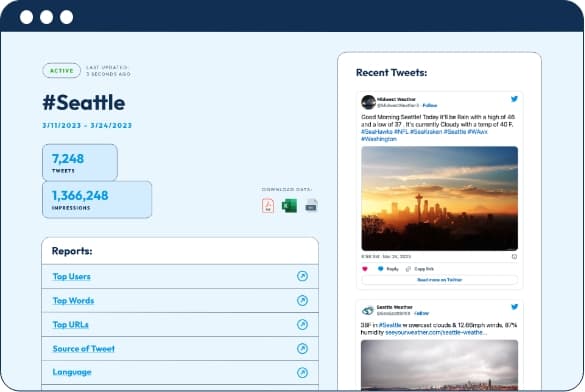
For organizations and researchers who need to archive and analyze Twitter data at scale—whether it's your own account or tracking specific hashtags, keywords, and conversations—Tweet Archivist's advanced archiving features provide enterprise-grade search, filtering, and analytics capabilities that go far beyond the basic archive download.
Best practices for managing your Twitter archive include requesting a new archive periodically (quarterly or annually) to maintain an up-to-date backup, storing archive files securely since they contain your complete Twitter history including DMs, and considering privacy before sharing archive data with others.
Method 4: Third-Party Search Tools
Third-party tools extend Twitter's native search capabilities, offering features like bulk downloading, advanced analytics, unlimited scrolling, and specialized search interfaces. While these tools require granting account access, they often provide functionality unavailable through Twitter's official features.
AllMyTweets stands out for its simplicity. Visit allmytweets.net, enter any username (including your own), and the service loads up to 3,200 of that user's most recent tweets on a single scrollable page. Use your browser's built-in search (Ctrl+F or Cmd+F) to instantly find keywords across thousands of tweets. This approach works particularly well when you know roughly what you're searching for but need to browse through historical content quickly.
TweetDeck, now owned by Twitter/X, offers a professional dashboard interface with powerful column-based searching. You can create custom columns with specific search queries—including all the search operators mentioned earlier—that update in real-time. Set up a column tracking your old tweets by date range, another monitoring competitor content, and a third following industry hashtags. TweetDeck excels for ongoing monitoring rather than one-time searches.
Tweet Binder specializes in comprehensive Twitter analytics and historical searches. Their platform generates detailed reports analyzing up to 35,000 tweets based on your search criteria, including hashtag performance, user influence, engagement metrics, and temporal patterns. The service offers both free limited searches and premium plans for extensive analysis.
Twilert functions like a Google Alert for Twitter, sending email notifications when specific keywords, hashtags, or mentions appear in tweets. Beyond real-time alerts, Twilert's historical search feature lets you search old tweets without downloading entire archives, making it valuable for brand monitoring and competitive research.
Snapbird penetrates deeper into Twitter history than standard search, accessing tweets that normal Twitter search overlooks. The tool searches your tweets, others' tweets, your direct messages (with permission), and your favorites/likes. Snapbird's interface is straightforward: select the search type, enter the username and keywords, and let it retrieve historical matches.
For comprehensive Twitter archiving, searching, and analytics—particularly for business, research, and compliance needs—Tweet Archivist offers professional-grade tools that combine powerful search capabilities with long-term data preservation, detailed analytics, and exportable reports.
Important security considerations: Any third-party tool requires OAuth access to your Twitter account. Review permissions carefully, grant access only to reputable services, and revoke access immediately after completing your search if you won't use the tool regularly. Navigate to Settings > Security and Account Access > Apps and Sessions > Connected Apps to review and revoke third-party access.
Finding Your Own Old Tweets
Searching your own Twitter history requires slightly different strategies than searching others' tweets, since you have access to additional methods like archive downloads and may want to analyze your content patterns over time.
The fastest method for finding your own tweets uses the from: operator combined with keywords and dates. Open Twitter's search bar and type: from:yourusername keyword since:2023-01-01 until:2023-12-31
Replace "yourusername" with your actual Twitter handle (without the @ symbol), "keyword" with terms you remember from the tweet, and adjust dates to your target timeframe. This instantly filters your timeline to show only relevant tweets.
If you don't remember specific keywords but recall the approximate timeframe, search by date alone: from:yourusername since:2024-06-01 until:2024-06-30
This displays all your tweets from June 2024, letting you scroll through that month's activity.
To find your most successful tweets—useful for content strategy and understanding what resonates with your audience—add engagement filters: from:yourusername min_faves:100 min_retweets:20
This query surfaces your tweets that achieved at least 100 likes and 20 retweets, helping you identify high-performing content patterns.
For tweets containing media (images or videos), add the filter operator: from:yourusername filter:media since:2024-01-01
When you need access to tweets beyond the 3,200-tweet limit, downloading your Twitter archive becomes essential. Follow the archive download process detailed in Method 3 above. Your archive provides searchable access to every tweet you've ever posted, regardless of Twitter's API limitations.
Another practical approach combines Twitter's native search with browser bookmarking. Create searches for common queries you run repeatedly—like finding your tweets about specific topics or from specific years—and bookmark the results pages. These bookmarked searches become instant shortcuts to filtered views of your Twitter history.
For those building a Twitter presence as part of a broader social media growth strategy, Bulkoid provides services that complement content discovery with audience growth, helping you not just find your best past content but amplify your reach moving forward.
Finding Someone Else's Old Tweets
Searching another user's Twitter history follows the same basic principles as searching your own, with the key difference that you can't access their archive download or private information. You're limited to publicly available tweets and Twitter's API restrictions.
Start with the from: operator and the target user's handle: from:elonmusk since:2020-01-01 until:2020-12-31
This searches all publicly available tweets from that user within your specified timeframe. Remember that if the user has protected tweets, you can only search their history if they've approved you as a follower.
When researching specific topics in someone's history, combine the from: operator with keywords: from:username "artificial intelligence" since:2023-01-01
Quotation marks ensure you're searching for the exact phrase rather than tweets containing "artificial" and "intelligence" separately.
To find conversations between two users, combine from: and to: operators: from:user1 to:user2
This reveals user1's tweets replying to or mentioning user2, useful for tracking public conversations and interactions.
For competitive research and brand monitoring, engagement filters help identify influential tweets: from:competitor min_retweets:100 filter:links
This query finds your competitor's tweets that gained significant traction and included links—likely their most successful promotional content.
AllMyTweets works excellently for browsing someone else's recent 3,200 tweets on a single page. Simply enter their username at allmytweets.net and use your browser's search to find specific keywords within their history. This method works without requiring any account access or permissions.
Some users periodically delete old tweets to maintain their online presence or privacy. If you're searching for deleted content, Twitter's native search won't help. However, the Wayback Machine (archive.org) sometimes captures Twitter profiles. Enter the user's profile URL into the Wayback Machine to see if archived snapshots exist from your target timeframe.
For enterprise-level social listening, brand monitoring, and competitive analysis, Tweet Archivist's monitoring tools offer sophisticated search and archiving capabilities that go far beyond manual searching, providing automated tracking, sentiment analysis, and comprehensive reporting.
Legal and ethical considerations matter when searching others' tweets. While public tweets are publicly available information, context matters—particularly when using historical tweets for journalism, research, or business intelligence. Always respect Twitter's terms of service and applicable privacy regulations in your jurisdiction.
Searching Old Tweets on Mobile
Twitter's mobile apps for iOS and Android present limitations compared to desktop functionality, most notably the absence of the Advanced Search graphical interface. However, mobile users can still access powerful search capabilities through search operators entered directly in the search bar.
The mobile search bar accepts all the same operators detailed in Method 2 above. Open the Twitter app, tap the search icon (magnifying glass), and type your operator query exactly as you would on desktop: from:username since:2024-01-01 until:2024-06-30
Mobile browsers provide an alternative path to full Advanced Search functionality. Open Safari on iOS or Chrome on Android, navigate to twitter.com (not the app), and request the desktop site. This loads Twitter's full web interface, giving you access to Advanced Search at twitter.com/search-advanced.
Some users prefer creating search shortcuts for mobile. Perform your search on desktop with the desired operators, bookmark the results page, then sync bookmarks to your mobile browser. These bookmarked searches become one-tap shortcuts to filtered Twitter views.
Third-party tools like AllMyTweets and Snapbird work in mobile browsers, providing alternative interfaces optimized for browsing historical tweets. These web-based tools don't require app installation and function identically on mobile and desktop browsers.
For the most efficient mobile experience, master the core search operators—from:, since:, until:, and basic keyword searches. These cover 80% of typical search needs without requiring Advanced Search access. Save complex, multi-operator searches for desktop sessions where you can see more tweets per screen and navigate results more efficiently.
Twitter's mobile limitations reflect broader platform trends prioritizing real-time content over historical search. The company has consistently optimized mobile apps for content consumption and engagement rather than deep research and analysis, reinforcing why desktop browsers and specialized tools remain superior for serious historical searching.
Finding Deleted Tweets
Deleted tweets present special challenges since Twitter removes them from all official search results and user timelines. However, several methods can recover deleted content depending on timing, popularity, and archival coverage.
The Wayback Machine (archive.org) represents your best option for finding deleted tweets. This nonprofit digital archive periodically crawls and saves web pages, including Twitter profiles and individual tweet pages. Enter the tweet's URL or user profile URL into the Wayback Machine calendar, select a snapshot date when the tweet existed, and browse archived versions of that page.
The Wayback Machine's coverage varies significantly by account popularity. High-profile accounts and viral tweets get archived more frequently, while average users may have sparse or nonexistent coverage. Nevertheless, it costs nothing to check and takes only seconds.
Ghostarchive specializes in social media preservation, focusing specifically on platforms like Twitter. This service archives tweets, including images, videos, and media attachments that other archival tools sometimes miss. Search Ghostarchive's database by username, keyword, or URL to see if the deleted tweet was preserved.
Google Cache occasionally stores recent Twitter pages in its search cache. Search Google for the tweet's URL or use the cache: operator followed by the tweet URL: cache:https://twitter.com/username/status/1234567890
Google's cache refreshes frequently, so this method works only for recently deleted tweets—typically within days or weeks of deletion, not months or years.
If you previously interacted with the tweet—liked it, retweeted it, replied to it, or bookmarked it—check your Twitter notifications and activity history. Twitter's notifications panel preserves interaction records even after original tweets disappear, showing you the deleted tweet's text in your notification history (though images and videos won't display).
For tweets you know were screenshots and shared elsewhere, reverse image search tools like Google Images or TinEye might locate preserved copies. Search the tweet's text as a quoted phrase, and include "twitter" or "tweet" in your query to filter results.
Organizations concerned with compliance, legal discovery, or brand monitoring should implement proactive archival systems rather than relying on reactive deleted-tweet searches. Tweet Archivist's real-time archiving captures tweets as they're posted, preserving complete records regardless of later deletion.
Legal considerations around deleted tweets vary by jurisdiction and use case. While publicly posted tweets have no expectation of privacy, using archived versions of deleted tweets for harassment, defamation, or other harmful purposes may violate laws or platform policies. When in doubt, consult legal counsel before using deleted tweet content publicly.
Search Limitations and Workarounds
Understanding Twitter's search limitations helps you choose the right tools and set realistic expectations for finding old tweets.
The 3,200 Tweet Limit: Twitter's API restricts timeline access to approximately 3,200 of a user's most recent tweets. Search through the main interface, Advanced Search, and search operators all respect this limitation. If you're searching an account with more than 3,200 total tweets, older content won't appear in search results.
Workaround: Download your Twitter archive (for your own account) or use Tweet Archivist for comprehensive historical archiving beyond API limits.
Search Index Incompleteness: Twitter's search doesn't index every tweet ever posted. Lower-engagement tweets from years ago, tweets from suspended accounts, and tweets from users who've since protected their accounts may not surface in searches even if they technically still exist.
Workaround: Combine multiple search methods. If Advanced Search returns no results, try searching via archive download or third-party tools that maintain their own indexes.
Date Range Restrictions: While you can search back to March 2006 theoretically, practical results diminish for very old content. Twitter's database retention policies, account deletions, and changing API structures mean searching tweets from 2006-2010 often yields incomplete results.
Workaround: Use the Wayback Machine to access historical snapshots of Twitter profiles from that era.
Protected Accounts: Tweets from protected accounts (users who've set their profile to private) appear only to approved followers. No search method—official or third-party—can surface protected tweets unless you're an approved follower.
Workaround: None for external searches. If you need access to someone's protected tweet history, request to follow them and wait for approval.
API Rate Limits: Third-party tools face Twitter API rate limits that restrict how many searches they can perform per hour. Aggressive searching might trigger temporary lockouts or reduced functionality.
Workaround: Space out intensive searches across multiple sessions, or use premium tools like Tweet Archivist with higher API allocations.
Mobile App Limitations: Twitter's iOS and Android apps lack Advanced Search and provide limited filtering options compared to desktop.
Workaround: Use mobile browsers to access twitter.com with desktop mode enabled, or use search operators directly in the mobile app's search bar.
Media Expiration: Very old tweets may have text preserved but images or videos deleted or expired. Twitter doesn't guarantee permanent media storage, and links to external images sometimes break.
Workaround: Check the Wayback Machine for archived versions that captured media when the tweet was fresh.
For businesses, researchers, and compliance teams who need reliable, comprehensive Twitter data without these limitations, Tweet Archivist's analytics platform provides professional-grade archiving that captures and preserves complete tweet data—text, media, metadata, and engagement metrics—bypassing platform limitations entirely.
Best Practices and Pro Tips
Mastering Twitter search requires more than knowing the tools—strategic approaches and efficiency tips separate casual users from power searchers.
Build a Personal Search Library: Create a document of your most common search queries with operators already formatted. When you need to find your tweets about "content marketing" from 2023, paste your pre-written query rather than reconstructing it from memory. Save this document in a note-taking app with quick access from any device.
Bookmark Powerful Searches: Twitter search URLs encode all your operators and filters. Bookmark searches you run repeatedly—your top tweets by engagement, mentions from specific date ranges, competitor monitoring queries—creating instant one-click access to filtered results.
Use Engagement Metrics Strategically: When searching old tweets for content inspiration or competitive research, engagement filters surface what actually worked. A tweet with 500+ likes from 2022 performed well for a reason—analyze its structure, timing, hooks, and topics for replicable patterns.
Combine Operators Creatively: The most powerful searches stack multiple operators: from:username "keyword phrase" since:2023-01-01 until:2023-12-31 min_faves:50 filter:images finds that user's image tweets about your keyword with decent engagement from a specific year. Experiment with combinations for highly targeted results.
Search Competitors Regularly: Schedule monthly searches of key competitors using operators like: from:competitor min_retweets:100 since:2024-01-01 to identify their best-performing content. Analyze patterns in their successful tweets to inform your own strategy.
Archive Proactively, Not Reactively: Don't wait until you desperately need an old tweet to start archiving. Download your Twitter archive quarterly, maintaining a chronological backup series. This practice protects against data loss, account issues, and platform changes.
Master Date Arithmetic: Calculate date ranges before searching to save time. Searching "Q1 2024" means since:2024-01-01 until:2024-03-31. "Last year this month" from November 2024 means since:2023-11-01 until:2023-11-30. Pre-calculate rather than guessing dates.
Respect API Limitations: Third-party tools often impose daily search limits. Plan important searches during business hours when you can act on findings immediately, rather than burning through API calls on casual evening browsing.
Document Your Findings: When conducting research through old tweets, screenshot or archive relevant findings as you discover them. Twitter's ephemeral nature means tweets can be deleted, accounts suspended, or content made private at any time. Preserve what matters immediately.
Verify Tweet Context: Old tweets appear without surrounding conversation threads in search results. Before citing or sharing historical tweets, click through to see the full context—the tweet might be part of a longer thread that changes its meaning.
For organizations implementing comprehensive social media archiving and analytics strategies, establishing proper workflows, compliance procedures, and data retention policies ensures you're not just finding old tweets but systematically preserving and analyzing Twitter data for long-term business value. Tweet Archivist's enterprise solutions provide the infrastructure, tools, and support to implement these best practices at scale.
Keep Learning: Twitter occasionally updates search functionality, adds new operators, or changes API access. Follow Twitter's developer blog and social media search specialist accounts to stay current with new capabilities and deprecations.
The ability to find old tweets transforms from a frustrating challenge to a manageable skill once you master these methods. Whether you're searching your own tweet history for that perfect post to resurrect, conducting competitive research, tracking brand mentions over time, or maintaining compliance archives, the combination of Twitter's native tools, search operators, archive downloads, and specialized third-party platforms puts comprehensive Twitter history at your fingertips.
Start with the method that matches your immediate need—Advanced Search for one-off searches, operators for regular power-user queries, archive downloads for complete personal history, or Tweet Archivist for professional-grade archiving and analytics. As your skills develop, you'll naturally combine approaches, building a personal toolkit optimized for your unique search patterns and research needs.